Largest Stadium in the World (2026): Full Capacity Ranking
On this page7
- 01Which stadium is the largest in the world in 2026?
- 02How we ranked stadium capacity
- 03World’s largest stadiums by capacity (2026)
- 04Why is the North Korean capacity figure disputed?
- 05Largest by seated capacity versus venues with standing room
- 06Why do Michigan Stadium and Beaver Stadium dominate the American list?
- 07Which stadium could top the list next?
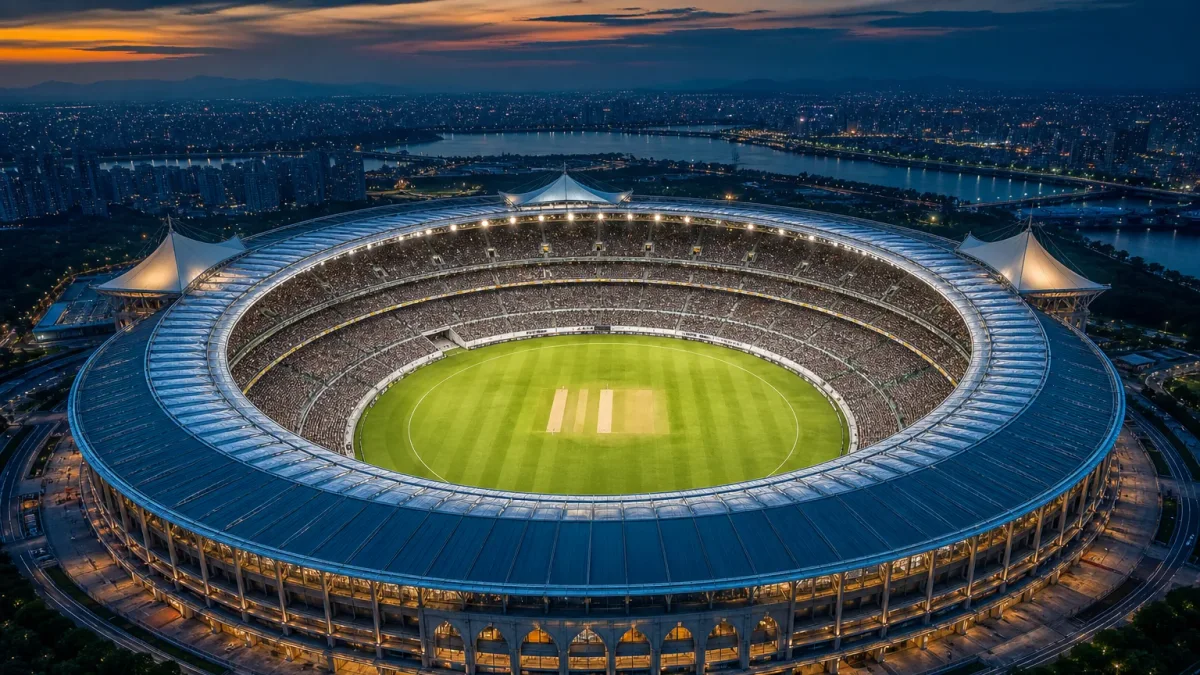
The largest stadium in the world is the Narendra Modi Stadium in Ahmedabad, India, which holds 132,000 spectators. Second is the Rungrado 1st of May Stadium in Pyongyang, North Korea, at roughly 113,000 on independent seat counts. Below those two, every venue that clears 100,000 is either an American college football stadium or the Melbourne Cricket Ground.
Which stadium is the largest in the world in 2026?
Narendra Modi Stadium, by a margin of almost 19,000 seats. It is a cricket ground, which is why it goes missing from lists written for football audiences. The old Motera stadium on the site was demolished in 2015 and rebuilt to a Populous design by contractor Larsen & Toubro, reopening in February 2020 at a reported cost of ₹800 crore (roughly US$100 million). It was renamed for the Indian prime minister in February 2021. The Gujarat Cricket Association owns and operates it.
That cost is the number most lists leave out, and it reframes the whole ranking. At about $760 per seat, the world’s biggest stadium was built for around a fiftieth of what SoFi Stadium and the modern NFL venues cost per seat.
How we ranked stadium capacity
The order uses active venues’ permanent normal capacity, checked in August 2026. It includes permanent standing areas when the operator counts them, but excludes temporary seats, record attendances, racecourse licences and motorsport circuits. Venues under reconstruction are ranked only at capacity currently available for use. Where official and independently counted figures conflict, the table uses the better-supported count and explains the dispute.
World’s largest stadiums by capacity (2026)
Capacity here is permanent total capacity, including permanent standing areas and excluding temporary seating. Costs are as originally reported, not inflation-adjusted.
| # | Stadium | Capacity | City, country | Opened | Build / rebuild cost | Owner or operator | Main sport |
|---|---|---|---|---|---|---|---|
| 1 | Narendra Modi Stadium | 132,000 | Ahmedabad, India | 2020 (rebuild) | ₹800 crore (~US$100m) | Gujarat Cricket Association | Cricket |
| 2 | Rungrado 1st of May Stadium | 113,281 | Pyongyang, North Korea | 1989 | Not disclosed | DPRK government | Football, mass games |
| 3 | Michigan Stadium | 107,601 | Ann Arbor, USA | 1927 | $950,000; $226m 2010 works | University of Michigan | College football |
| 4 | Beaver Stadium | 106,572 | University Park, USA | 1960 | $1.6m; $700m rebuild under way | Penn State University | College football |
| 5 | Ohio Stadium | 102,780 | Columbus, USA | 1922 | $1.34m | Ohio State University | College football |
| 6 | Kyle Field | 102,733 | College Station, USA | 1927 | $485m 2013–15 rebuild | Texas A&M University | College football |
| 7 | Tiger Stadium | 102,321 | Baton Rouge, USA | 1924 | $1.82m (1936 horseshoe) | Louisiana State University | College football |
| 8 | Neyland Stadium | 101,915 | Knoxville, USA | 1921 | $42,000; $136.4m 2004–10 works | University of Tennessee | College football |
| 9 | Darrell K Royal–Texas Memorial Stadium | 100,119 | Austin, USA | 1924 | $275,000 | University of Texas | College football |
| 10 | Bryant–Denny Stadium | 100,077 | Tuscaloosa, USA | 1929 | $196,000 | University of Alabama | College football |
| 11 | Melbourne Cricket Ground | 100,024 | Melbourne, Australia | 1853 | A$725m (redevelopments) | Victorian Government / Melbourne Cricket Club | Cricket, Australian rules |
| 12 | FNB Stadium | 94,736 | Johannesburg, South Africa | 1989, rebuilt 2009 | ZAR 3.3bn (~US$440m) rebuild | City of Johannesburg / Stadium Management SA | Football, rugby |
None of these venues carries a corporate naming-rights deal. That is unusual at this scale, and it is a direct consequence of who owns them: universities, national governments and member-owned clubs, none of which need to sell the name on the building.
Why is the North Korean capacity figure disputed?
Because no independent body has ever been allowed to audit it. North Korean state media put Rungrado 1st of May Stadium at 150,000, a figure repeated for decades and still quoted in tourist material. The venue does have around 80 entrances, and official sources say those can admit 150,000 people in 15 minutes.
The problem is seats. When StadiumDB’s editors counted every seat in the bowl from photography, including VIP and press areas, the total stopped just under 114,000. That is the basis for the 113,281 figure used above. Treat 150,000 as a claimed throughput number, not a verified seating capacity, and treat 113,281 as the best available count rather than an audited one.
The record for any football match — 173,850 at the 1950 World Cup final — was set on terraces and can never be broken; see highest attendance records. Old Trafford is the cleanest example in Britain: its 1939 record crowd of 76,962 exceeds its current capacity of 74,310, because terraces held more people than seats do — see Old Trafford capacity.
Largest by seated capacity versus venues with standing room
The ranking above mixes two different things, and separating them changes the order. All-seater venues like Narendra Modi Stadium and the American college stadiums report a seat count. Venues with permanent standing terraces report seats plus terrace allowance, so their listed capacity is not a seat count at all.
Two consequences follow. First, record attendances routinely exceed listed capacity: the Melbourne Cricket Ground’s listed 100,024 has been beaten by crowds packed into standing and temporary areas. Second, motorsport circuits and racecourses sit outside this list entirely, because their capacity is a licensed site figure rather than a stand figure. Tokyo Racecourse alone is licensed for 223,000, more than any stadium on earth, which is covered in the ranking of the world’s largest horse racing venues.
Why do Michigan Stadium and Beaver Stadium dominate the American list?
Because American universities built enormous bowls in the 1920s and never stopped adding to them, while professional leagues capped themselves. Michigan Stadium opened in 1927 with room for 72,000 and was expanded six times before the $226 million 2010 project. Beaver Stadium was literally moved and reassembled at its current site in 1960, then expanded nine times.
Professional football went the other way. The NFL’s old broadcast blackout rule punished any team that failed to sell out, so no franchise built far past 80,000 seats. The result is that eight college stadiums outrank every venue in the ranking of the biggest stadiums in the US, and the largest NFL stadium, MetLife, seats 82,500.
Europe is the clearest illustration of the problem: Camp Nou is the continent’s largest by design at 105,000 but only ~62,652 is usable mid-rebuild, so the largest stadium in Europe has two correct answers.
Britain is a useful illustration of how quickly these figures move: four grounds sit within 2,000 seats of each other and two are mid-expansion, which is why published figures conflict. See our guide to the biggest stadiums in the UK.
Which stadium could top the list next?
Nothing under construction beats 132,000. The Grand Stade Hassan II, being built on a 100-hectare site near El Mansouria north of Casablanca, is designed for about 115,000 with completion targeted for late 2028 and a reported budget near 5 billion dirhams. That would put it second, ahead of Rungrado.
Two other projects are worth watching. Penn State’s $700 million Beaver Stadium revitalization should push capacity to roughly 108,000 to 109,000 during the 2026 season, taking the American record from Michigan before the project finishes in 2027. And Spotify Camp Nou is heading for 105,000 once Espai Barca completes; through 2026 it has been operating under a partial licence at around 62,600, so it is deliberately left out of the table above rather than listed at a capacity it cannot currently use.
Bookmark the stadiums hub for the capacity tables as these rebuilds land.
Separate rankings cover the largest indoor arenas, the biggest soccer stadiums, and the most expensive stadium in the world, where size and construction cost produce different orders.
Review class: event-driven. Recheck when Beaver Stadium’s expanded capacity is confirmed after the 2026 season, and as other rebuilds land.
Frequently asked questions
What is the largest stadium in the world?+
Narendra Modi Stadium in Ahmedabad, India, with a capacity of 132,000. It is a cricket ground rather than a football stadium, which is why it is often missed on European lists. It was rebuilt on the old Motera site and reopened in February 2020, then renamed in February 2021.
Is Rungrado 1st of May Stadium bigger than Narendra Modi Stadium?+
No. North Korean state sources have long quoted 150,000 for Rungrado, which would make it the largest, but nobody outside the country has confirmed that number. An independent seat-by-seat count by StadiumDB stopped just under 114,000, so 113,281 is the figure most reference lists now carry.
How many stadiums in the world hold more than 100,000 people?+
Eleven, as of 2026. Two are outside the United States: Narendra Modi Stadium at 132,000 and Rungrado 1st of May Stadium at 113,281. Eight are American college football venues, and the eleventh is the Melbourne Cricket Ground at 100,024.
What is the largest stadium in Europe?+
Spotify Camp Nou in Barcelona will be the largest at 105,000 once the Espai Barca rebuild finishes. While that work continues it is operating well below capacity, so Wembley Stadium in London and its 90,000 seats is the largest European venue running at full size in 2026.
What was the largest stadium ever built?+
Great Strahov Stadium in Prague, which held around 250,000 spectators and was built for mass gymnastics displays. It no longer stages competitive sport, so reference lists exclude it. On that basis it is the biggest sports venue ever constructed by some distance.
Which stadium will be the largest in the world next?+
None currently under construction beats 132,000. The Grand Stade Hassan II near Casablanca is being built to hold about 115,000 with completion targeted for late 2028, which would move it past Rungrado into second place but leave Narendra Modi Stadium on top.
Is Michigan Stadium still the biggest stadium in the United States?+
For now. Michigan Stadium's official capacity is 107,601, ahead of Beaver Stadium at 106,572. Penn State expects Beaver Stadium to reach roughly 108,000 to 109,000 during the 2026 season as its new west-side upper bowl opens, which would take the American record.
Do these capacity figures include standing room?+
The reference figures used here are permanent total capacity, including any permanent standing areas but excluding temporary seating. That matters for venues like the Melbourne Cricket Ground and FNB Stadium, and it is why record single-event attendances often exceed the listed capacity.
Sources
Related stadiums & arenas guides
View all →
Biggest Stadium in the US (2026): Top 20 by Capacity
Michigan Stadium is the biggest stadium in the US at 107,601. See the top 20 ranked with capacity, year opened, build cost, owner and naming rights.
Largest Stadium in Europe: Two Correct Answers
Camp Nou is Europe's biggest on paper at 105,000 but only ~62,652 is usable mid-rebuild. Wembley is the largest actually in use. The full ranked table.

Largest NFL Stadiums 2026: All 30 Ranked by Capacity
MetLife Stadium is the largest NFL stadium at 82,500. All 30 venues ranked with capacity, year opened, construction cost and naming-rights holder.
Principality Stadium Capacity: 73,931 and a Roof
Cardiff holds 73,931 for rugby and about 78,000 for boxing. And the famous rule that both teams must agree to close the roof no longer applies.
Twickenham Capacity, and the £100m Rename
Twickenham holds 82,000 — the largest rugby union stadium in the world. Owned by the RFU, and renamed Allianz Stadium in 2024 after 115 years.
Wembley Stadium Capacity, Cost and Who Owns It
Wembley holds 90,000 — the UK's largest. What it cost to build, who owns it, why the arch exists, and how the capacity changes by event.